The Lehman Moment: The “Normalization” of Fraud

Until the federal and state governments are willing to tell the American public that they gambled away their pension funds on Wall Street there will be no ptocecutions – because with prosecutions the truth comes out. There are already too many sealed files in these bank related cases. Transparency is a necessity… But then our governments don’t think the American public can handle the truth.

Unknown's avatarLivinglies's Weblog

Sept. 15 is the eighth anniversary of the Lehman Brothers bankruptcy. Not enough time has passed yet for me to recall those anxious days without getting angry.

 Sen. Elizabeth Warren, D-Massachusetts, has used the occasion of this anniversary to suggest the next administration should “investigate and jail” those Wall Street bankers who committed crimes. Although I doubt there will be any perp walks, I do have some ideas about how to proceed.

Before we look into the senator’s suggestion, it is time for an honest appraisal of one of the lingering mysteries of the financial crisis: Why were there were no prosecutions of major executives?

It’s a fair question. I believe there were 10 areas where fraud and abuse took place. These were the Mortgage Electronic Registration Systems; mortgage pools; securitization; “misplaced” mortgage notes; force-placed insurance; servicing fees; fake documents; false affidavits, perjury and robo-signing; foreclosure mills…

View original post 626 more words

Wells Fargo customers livid over phantom accounts

justiceleague00's avatarJustice League

Brian Kennedy was surprised when he logged onto the Wells Fargo website to pay his mortgage and discovered he had a checking account he never asked for.

And it had a negative balance of $60 for two months of fees and penalties.

Kennedy went to his local Wells Fargo branch to complain, and the account was promptly closed. But the bank charged him a $1 fee for the privilege. He reached into his pocket and handed the bank officer a dollar bill to close the account he never wanted.

“It really pissed me off,” said Kennedy, a retiree in Westminster, Maryland. “They expect people to not be paying attention and hope you don’t notice. I’ve got a high credit score and I want to keep it that way. As soon as rates drop enough I’m going to refinance out of their mortgage.”

Wells Fargo (WFC) has agreed to

View original post 152 more words

Workers and former employee tell Wells Fargo horror stories

justiceleague00's avatarJustice League

wells fargo fake account employeeCharlotte Observer:

Julie Miller was working in Pennsylvania for Wachovia when Wells Fargo took over the Charlotte bank in 2008 and began changing more than the name on its branches.

Miller said she watched with dismay as Wells Fargo increased her branch’s sales goals and lowered bonuses for meeting the new targets. The changes took place around 2011, when her branch converted to the Wells Fargo name, she said.

“It became a living nightmare,” said Miller, 52, who no longer works for Wells Fargo. “They almost doubled our goals and decreased our incentive pay. It drove me to drink.”

Miller said her health began deteriorating as she tried to meet daily requirements that her branch sell 42 products, like mortgages and lines of credit, and open seven checking accounts.

That’s when she also started noticing Wells Fargo customers complaining they were being signed up for products they never asked for.

View original post 320 more words

Wells Fargo fined $185 million for Fraudulently Opening Accounts for Customers

Unknown's avatarLivinglies's Weblog

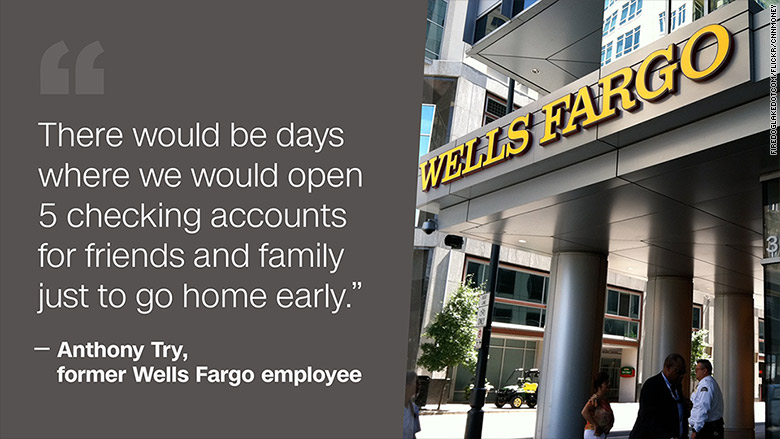
For years, Wells Fargo employees secretly issued credit cards without a customer’s consent. They created fake email accounts to sign up customers for online banking services. They set up sham accounts that customers learned about only after they started accumulating fees.

On Thursday, these illegal banking practices cost Wells Fargo $185 million in fines, including a $100 million penalty from the Consumer Financial Protection Bureau, the largest such penalty the agency has issued.

Federal banking regulators said the practices, which date back to 2011, reflected serious flaws in the internal culture and oversight at Wells Fargo, one of the nation’s largest banks. The bank has fired at least 5,300 employees who were involved.

In all, Wells Fargo employees opened roughly 1.5 million bank accounts and applied for 565,000 credit cards that may not have been authorized by customers, the regulators said in a news conference. The bank has 40…

View original post 982 more words

Deutsch Bank: Going Down With the Details

If it’s true… Finally. Or maybe they have finally begun to realize their pensions and investments don’t exist.

Unknown's avatarLivinglies's Weblog

It is getting increasingly obvious to the courts that there is something inherently wrong with foreclosures. The substitutions without leave of court and the repeated filing for foreclosure on the same default are coming back to bite the ‘securitization fail” scheme of the banks.

see http://www.newyorklawjournal.com/id=1202766695379/Deutsche-Bank-Trust-Co-Americas-v-Smith-20152381?kw=Deutsche%20Bank%20Trust%20Co.%20Americas%20v.%20Smith%2C%202015-2381&cn=20160907&pt=Daily%20Decisions&src=EMC-Email&et=editorial&bu=New%20York%20Law%20Journal&slreturn=20160807093854

If you start with the premise that the trusts were never funded and therefore never existed, everything starts to make sense. In ordinary circumstances with ordinary loans the pronouncement of every bank foreclosure attorney rings hollow: “Judge this is a standard foreclosure.” If that were true they wouldn’t be losing cases procedurally, allowing them to linger sometimes for a decade or more, and they wouldn’t be trying to slip in a “substitution of Plaintiff” without leave of court. And they probably would not be foreclosing on so many dead people.

This case, decided today, gives us an example of how things can go wrong…

View original post 624 more words

NEW CFPB RULES TO THWART WRONGFUL FORECLOSURES

justiceleague00's avatarJustice League

The Consumer Financial Protection Bureau (CFPB) approved rues on August 5, 2016, to help prevent wrongful home foreclosures.

Mortgage servicers will be required to promptly notify borrowers when loss mitigation applications are complete.  Many mortgage servicers never considered an application complete and repeatedly demanded information and documents that the borrower had already provided.  Many borrowers complained that the servicers often demanded federal income tax returns over and over.  Borrowers were required to make adjusted monthly payments while the applications were pending.  The repeated stalling benefited the banks and servicers.  Many borrowers reported that when their applications were finally refused, the interim payments were never credited to their accounts.  Servicers are also prohibited from dual tracking – pursuing both a modification and a foreclosure simultaneously.

[Read More]

View original post

Eerie Photos Explore Homes Abandoned in the Housing Crisis

Moral decay stems on Wall Street…

Unknown's avatarLivinglies's Weblog

http://www.miaminewtimes.com/news/fiu-grads-eerie-photos-explore-homes-abandoned-in-the-housing-crisis-8735937

Five years ago, as a journalism student at Florida International University, Nicole Taylor-Lang began thinking of ways to flesh out her photography portfolio. She didn’t have to look far: Only a block from her Greenacres home in Palm Beach County, she found the first subject of what would become a years-long passion project.

It was a white and beige house with boarded-up windows and a chimney shooting out of one corner. The yard was overgrown with weeds, and it looked like no one had lived there in several years.

“It had a very Little House on the Prairie feel,” Taylor-Lang says. “That house I call my baby. All of a sudden, it just started intriguing me, [these] abandoned properties.”

Since then, Taylor-Lang has traveled South Florida photographing empty homes and businesses to document the aftermath of the housing crisis, which continues to scar the landscape nearly eight years after it began. Some…

View original post 298 more words

Recording Requirements: When “Duly Acknowledged” Is Not Enough

How many times have we all pondered why the banks never signed or acknowledged the documents? Most homeowners signed 2 sets of loan documents – and when questioning why 2 sets, most were told that the bank would send them back a confirmation set… But that never happened, did it? Would we have “voluntarily” signed 2 sets if we knew then what we know now? Doubtful we would have even signed one.

BankruptcyRealEstateInsights's avatarBankruptcy-RealEstate-Insights

DeGiacomo v. First Call Mortgage Company (In re Reznikov), 548 B.R. 606 (Bankr. D. Mass. 2016)

A chapter 7 trustee sought to avoid a recorded mortgage based on a defective acknowledgment and then to preserve the lien of the mortgage for the benefit of the bankruptcy estate. The mortgagee objected – arguing that the acknowledgment was sufficient, and the debtor objected – claiming a homestead exemption in the property.

View original post 859 more words

Wells Fargo, U.S. Trustee Program Reach Mortgage Settlement

Unfortunately, it appears that the overall articles fails to determine why the USTP reduced the settlement to less than 5% of the original amount. “Wells Fargo previously agreed to pay about $81.6 million in remediation”

Probably because the the trustees can’t take a cut – as they get paid first out of any bankruptcy proceeding with administrative costs. Likely, a settlement like this may not fall in the category…or if it does won’t be much availability for 8000 victims ($437.50).

justiceleague00's avatarJustice League

Aug. 26 — The U.S. Trustee Program announced Aug. 25 that it has reached an agreement with Wells Fargo Bank, N.A. requiring the bank to pay close to $3.5 million in remediation on account of 8,000 homeowners in Chapter 13 bankruptcy.

Wells Fargo and the USTP filed an amendment to a prior settlement entered in a Maryland Chapter 13 bankruptcy case on Nov. 19, 2015 (In re Green, Bankr. D. Md., No. 11-33377-TJC, 8/25/16 ), according to a press release sent to Bloomberg BNA.

The amendment is the result of an independent reviewer’s oversight of Wells Fargo practices with regard to filing and serving payment change notices in active Chapter 13 cases, and increase payments to be made by the bank by approximately $3.5 million. Wells Fargo previously agreed to pay about $81.6 million in remediation for “its repeated failure to provide homeowners with payment change notices (PCNs) as…

View original post 25 more words

Michigan sets parole for ‘Linda Green’ robo-signer

Unknown's avatarLivinglies's Weblog

http://www.detroitnews.com/story/business/2016/08/28/michigan-sets-parole-linda-green-robo-signer/89525028/

By Brian O’Conner

The only person jailed in connection with a foreclosure forgery scandal that swept through Michigan and the rest of the country after the collapse of the housing bubble spends her days confined to the Women’s Huron Valley Correctional Facility in Pittsfield Township.

But not for long.

Sentenced in May 2013 to serve up to 20 years on racketeering charges, Lorraine Brown, now 55, will be paroled sometime this week, according to the Michigan Department of Corrections, after serving her 40-month minimum sentence. Brown will then be transferred to federal custody to serve the remainder of a 58-month federal sentence after pleading guilty to a single charge of conspiracy to commit mail and wire fraud.

Brown’s scheme netted $60 million between 2003 and 2006 for the parent company DocX, her Georgia-based document processing firm that forged more than 1 million foreclosure documents used by banks and attorneys…

View original post 1,038 more words