Ocwen’s William Erbey deserves a Passport to Prison- not Malta

And don’t think the banks they service for shouldn’t be their roommates!

Millionaire facing US investment fraud suit is Malta’s newest citizen

MaltaToday – Matthew Vella  – 16 June 2016, 8:10am

william_erbeyWilliam Erbey was forced to resign chairmanship of US mortgage giant Ocwen over serious conflicts of interest related to foreclosures on homeowners

‘Citizen Bill’: William Erbey was forced to resign the chairmanship of mortgage giant Ocwen for using the company to funnel business to his companies

One of the multi-millionaires lining up for a Maltese passport has run into trouble back in the United States, having to face a securities fraud lawsuit.

William Charles Erbey was a billionaire worth $2.5 billion and a regular in Forbes’ list of the global rich, but his worth was drastically reduced to ‘just’ over $400 million when his mortgage giant Ocwen Financial was found responsible for serious conflicts in the way it carried out its business.

But far from the ‘talent’ that Prime Minister Joseph Muscat shills for in his international roadshows with Henley & Partners flogging off Malta’s golden €650,000 passport, William Erbey is accused by critics of having built an empire on mortgage misery, and who saves tax by sheltering his companies in the Virgin Islands, Luxembourg and the Caymans.

Earlier this month, US District Judge William Dimitrouleas said Erbey would have to face a securities fraud lawsuit, after the plaintiffs had successfully alleged that he and his company Home Loan Servicing Solutions had misrepresented to investors that the company had controls over Erbey’s conflicts of interest.

In 2011, Ocwen was investigated by New York’s Department for Financial Services for incomplete documentation and record-keeping, falsification of evidence through “robo-signing” and pursuit of foreclosures without legal standing.

Ocwen was found having pushed homeowners into foreclosure and profiting by funnelling default-related business to William Erbey’s associated companies. For example, one subsidiary hosted Ocwen’s online auctions; another handled post-foreclosure real estate transactions.

Mortgage servicers like Ocwen are essentially debt collectors, collecting monthly principal and interest from homeowners.

db-lawsky-game-of-thrones-master675Prosecutor Benjamin Lawsky accused Ocwen of making decisions intended to benefit Erbey’s affiliated companies and their share price, “resulting in harm to borrowers, mortgage investors or Ocwen shareholders as a result.”

In addition to Ocwen Financial – which collected monthly mortgage payments – Erbey was also the chairman and the largest shareholder of four other real estate companies that step in when a lender has his property loan foreclosed. Altisource Portfolio Solutions ran the auction site Hubzu.com for foreclosed properties to go for a quick sale; Altisource Residential Corporation re-purposed a home as a rental property after acquiring it through a foreclosure auction; Altisource Asset Management offered reinsurance; and Home Loan Servicing Solutions was a holding company that purchases assets from… Ocwen.

In 2014, the New York Department of Financial Services reached a $150 million settlement with Ocwen, that included the resignation of executive chairman William Erbey from Ocwen and its four publicly traded affiliates.

Investors who own 25% in Ocwen-serviced trusts have now accused the company of forcing them to pay the cost of the settlements, saying Ocwen’s practices enriched its corporate affiliates while harming the trusts and their investors.

Ocwen has countered that its own independent investigation proves that those accusations hold no water.

Also in 2013, some 9,500 homeowners complained about how their mortgages had been serviced. The Consumer Financial Protection Board (CFPB) teamed up with authorities Ocwen consumer complaintsfrom 49 states to force Ocwen into a $2 billion settlement [a mere pittance] for use in loan reductions to homeowners struggling to stay afloat and $127.3 million in refunds for 185,000 people whose properties had already been foreclosed upon.

According to Richard Cordray, head of the CFPB, “Ocwen took advantage of borrowers at every stage of the process.”

In an interview with The New Republic in 2014, the former prosecutor Benjamin Lawsky said: “When a corporation does wrong, it has to be that individuals who work at the corporation have done wrong.”

Hey, somebody tell the foreclosure judges, would ya?! You know none of this is going to change until law enforcement confiscates the computer servicer software programs and the judiciary deems the software patents unlawful, invalid and dissolves or bans the use of this “seamless automation” of corruption.

Unknown's avatarLivinglies's Weblog

Erbey William Charles Erby- Ocwen’s Finest

http://www.maltatoday.com.mt/news/national/66489/millionaire_facing_us_investment_fraud_suit_is_maltas_newest_citizen#.V2MBeeYzZb0

Mortgage Titan and U.S. Citizen William Charles Erbey, who built Ocwen Financial into one of the country’s largest non-bank mortgage servicers, is having problems qualifying for a Maltese passport. Although there has been no reason provided for the holdup on William’s passport application, it could have something to do with the numerous securities violations Williams is accused of.   William Erbey is accused by critics of having built an empire on foreclosure misery, and who saves tax by sheltering his companies in the Virgin Islands, Luxembourg and the Caymans. In 2012 he relocated to the U.S. Virgin Islands.


Erbey applied for Malta’s €650,000 “Golden Passport” program. Malta has become a gateway for wealthy investors — mainly from politically unstable parts of the world — to secure a base in London. While expensive, it promises a straightforward citizenship program that allows participants to operate throughout the…

View original post 359 more words

Consumer Foreclosure: Lawyers May Need to Tread Lightly

Ta da!

BankruptcyRealEstateInsights's avatarBankruptcy-RealEstate-Insights

Jackson v ING Bank, FSB (In re Jackson), 545 B.R. 62 (Bankr. D. Mass 1916)

A chapter 13 debtor sued a mortgagee’s law firm asserting various claims based on the firm’s attempts to exercise remedies in connection with a defaulted mortgage loan, including wrongful foreclosure, breach of contract, deceit and misrepresentation, and violation of a bankruptcy discharge injunction and the Fair Debt Collection Practices Act (FDCPA). The debtor also objected to the mortgagee’s proof of claim.

View original post 1,105 more words

Discovery: Your BlackKnight in Shining Armor?

Unknown's avatarLivinglies's Weblog

http://www.bkfs.com/RealEC/DivisionInformation/SettlementAgents/ClosingInsightSettlementAgents/Pages/default.aspx

THE FOLLOWING ARTICLE IS NOT A LEGAL OPINION UPON WHICH YOU CAN RELY IN ANY INDIVIDUAL CASE. HIRE A LAWYER.

Maybe it is time to drill down a little deeper into ways to obtain Discovery. The same company that brought us the DOCX line of “original” fabricated documents has created a software platform used by the mega banks to streamline closings. Closing Insight and its predecessors (I think Chase uses its own version of this platform) could provide information on the real facts of each “closing”. Discovery requests should be directed to access the information on the platform which is now owned and operated by LPS/BlackKnight.


Note that most loans over the mortgage meltdown period that are still in existence were refi’s and not original loans. Most lawyers and judges presume that the closing paid off the old loan. But this is often not the case. Since the party…

View original post 523 more words

David Dayen,”Housing crisis has led to breakdown of the Social Order”

Gallery

This gallery contains 1 photo.

Livinglies's Weblog http://www.marketwatch.com/story/housing-crisis-has-led-to-breakdown-of-the-social-order-author-says-2016-06-08?link=sfmw_tw By Andrea Riquier Imagine the immense stack of papers that accompanies a home purchase closing. Excited home buyers sign, sign, and sign some more. They sign even more now since the 2015 introduction of new regulations required … Continue reading

Bank of America Attorney: “Government should stop looking for Fraud where it doesn’t Exist”

Very well positioned. They think they are protecting the banks from failing by allowing the the foreclosures to keep them liquid and stopping the fines for bad behavior. Let’s face it – the crash will likely wipe them out of retirement investments. Karma is a bitch.

If they really wanted to clean up the banks and protect American citizens they’d confiscate the computer programs and software designed to default America…and regulate the industry.

Unknown's avatarLivinglies's Weblog

BREAK THE BANKS VAULT2

By William Hudson

http://www.wsj.com/articles/appeals-court-throws-out-1-27-billion-penalty-against-bank-of-america-1464018896

The big banks have demonstrated to the world that they own everything including the courts, law enforcement and government officials. They have demonstrated this fact by rigging currency and economies, obtaining bailouts when they had no losses, foreclosing on loans they can’t prove they own, playing both sides of the market and by purchasing government representatives with “deals” they just can’t turn down. Meanwhile 318 million Americans have had their lives impacted or decimated by illegal banking practices.


In late May,  a federal appeals court ruled it will not hold Bank of America accountable for the sale of worthless mortgages, overturning a paltry $1.27 billion penalty they had been ordered to pay. A panel of three judges ruled that federal prosecutors had failed to prove that Bank of American’s Countrywide Mortgage division had defrauded Fannie Mae and Freddie Mac by selling them fatally flawed loans. Seriously…

View original post 846 more words

Renewing the Statute of Limitations Accidentally: Modifications and Payments

Unknown's avatarLivinglies's Weblog

It seems apparent to me that the banks are sidestepping the statute of limitations issue by getting homeowners to renew payments after the statute has run. Given the confusion in Florida courts it is difficult to determine with certainty how the statute will be applied. But the execution of a modification agreement would, in my opinion, almost certainly waive the statute of limitations, particularly since it refers to the part of the alleged debt that was previously barred by the statute. It would also, in my opinion, reaffirm a discharged debt in bankruptcy.

THE FOLLOWING ARTICLE IS NOT A LEGAL OPINION UPON WHICH YOU CAN RELY IN ANY INDIVIDUAL CASE. HIRE A LAWYER.

—————-

There are several reasons why servicers are offering modifications and several other reasons why they don’t.

My perception is that the main reason for offering the modification is that the servicer is converting the ownership of…

View original post 383 more words

Who Can Go After Banks for the Foreclosure Crisis?

Unknown's avatarLivinglies's Weblog

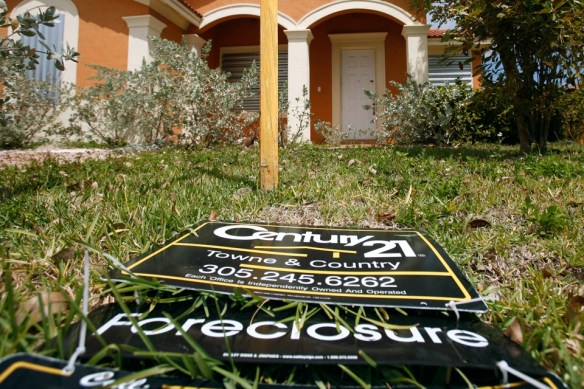
Foreclosures States FILE – In this March 24, 2009 file photo, a sign lies on the ground in front of a foreclosed home in Homestead, Fla. Officials in 49 states have launched a joint investigation into allegations that mortgage companies mishandled documents and broke laws in foreclosing on hundreds of thousands of homeowners. (AP Photo/J Pat Carter, File)

Editors Note: When Banks defraud American cities out of county recording fees and saddle them with the maintenance of foreclosed real estate that the banks have abandoned or neglected- cities lose revenue.  The cities are then unable to care for the homeless families that were displaced by the banks and may neglect to provide basic municipal services like public water, sanitation or maintain the infrastructure.

The city of Detroit is a perfect example of how a bankrupt city was unable to properly carry out its assigned responsibilities to its citizens due to financial deficiencies…

View original post 380 more words

4th DCA Florida: Exploding the Merger Myth

Unknown's avatarLivinglies's Weblog

Achieving standing via merger also requires that the surviving entity prove that it “acquired all of [the absorbed entity’s] assets, including [the] note and mortgage, by virtue of the merger.”Fiorito v. JP Morgan Chase Bank, Nat’l Ass’n, 174 So. 3d 519, 521 (Fla. 4th DCA 2015).

see http://4closurefraud.org/2016/06/07/fl-4th-dca-segall-v-wachovia-bank-na-reversed-wachovia-failed-to-prove-standing-to-foreclose/

Finally the courts are turning back to the simple rules of law that always applied until the era of false claims of securitization. Hopefully this decision will be persuasive authority in all jurisdictions. As stated in other cases, the banks can’t continue to operate using multiple choice assertions. Either their entity is real or it isn’t. Either they acquired the loan or they didn’t — and the fact that there was a merger does NOTHING for them in asserting transfer of the loan. They must show that the subject loan was in fact acquired by the surviving entity in the merger…

View original post 15 more words

UNSEALED: DOJ Confirms Holders of Securitized Loans Cannot Be Traced

Exactly what was just discussed. It’s time to put the judges on the hotspot – “please define the terminology your honor” – what do the words “transfer” and “sold” mean to you? Do the four corners of these notes and mortgages contracts allow for the distorting of legal principals without disclosure?

justiceleague00's avatarJustice League

Great job by 4closurefraud website!

Originally posted at http://mortgageflimflam.com
With additional edits by http://4closurefraud.org

In a filing unsealed on June 3, 2016, the Department of Justice (DOJ) confirms what many of us have known for years. Nobody, not even the U.S. Government, with massive resources, can determine who owns your loan and has the right to collect on your mortgage.

The information comes from case files unsealed on June 3, 2016 by federal Judge Yvonne Gonzalez Rogers of the Northern District of California in the case of the United States v. Discovery Sales, Inc. The case involves some 325 fraudulent loans originated by Discovery Sales, Inc. (DSI) between 2006 and 2008, many of which were then sold to Wells Fargo Bank and JP Morgan Chase to securitize.

The Discovery Sentencing document on page 9 states:

The originating lenders who made loans to purchase DSI properties, including Wells Fargo…

View original post 325 more words

One Step Closer: It’s Impossible to Tie Any Investors to Any Loan

THIS POST HAS BEEN MOVED TO GARFIELD’S BLOG:

Interesting thought here as I read Chain of Title which makes a point to say the investors don’t own the actual loan. We now have documents that identify the mortgagors as a third-party to the process between the banks (and of course they would have to be since they unwittingly, with no disclosure, pledged their collateral); and, agreements defining the unlimited use of the collateral assets to pledge, repledge, reuse, rehypothecate, hypothecate – all of which the homeowners did not agree or allow by contract. It is time to make judges define their understanding of the word “transfer” in the note and “sold” in the mortgage.

These are not traditional mortgages. The securitization and “procurement of collateral” agreements were pre-existing to the faux mortgage and note documents and the homeowner’s signature. However, there was no disclosure to the homeowner. These were internally contracted securities transactions.

BASIC INC. v. LEVINSON, 485 U.S. 224 (1988) identifies fraud on the market. Omission is just as serious as misrepresentation.

Unknown's avatarLivinglies's Weblog

The current talking points used by the Banks is that somehow the Trust can enforce the alleged loan even though it is the “investors” who own the loan. But that can only be true if the Trust owns the loan which it doesn’t. And naming the “investors” as the creditor does nothing to clarify the situation — especially when the “investors” cannot be identified.

THE FOLLOWING ARTICLE IS NOT A LEGAL OPINION UPON WHICH YOU CAN RELY IN ANY INDIVIDUAL CASE. HIRE A LAWYER.

—————-

see http://4closurefraud.org/2016/06/07/unsealed-doj-confirms-holders-of-securitized-loans-cannot-be-traced/

I know of a case pending now where US Bank allegedly sued as Trustee of what appears to be named Trust. In Court the corporate representative of the servicer admitted that the creditor was a group of investors that he declined to name. I knew that meant two things: (1) neither he nor anyone else knew which investor was tied to the subject…

View original post 975 more words