
By Sydney Sullivan
How to Prove Innocence When Falsely Accused of
Sexual Assault – Part 4
“…and if we were able to settle the civil case for $150,000.00 that she would leave the island and not appear at the trial of the criminal case.” Johnny Brown, attorneyAloha, and may God inspire you to follow this story.
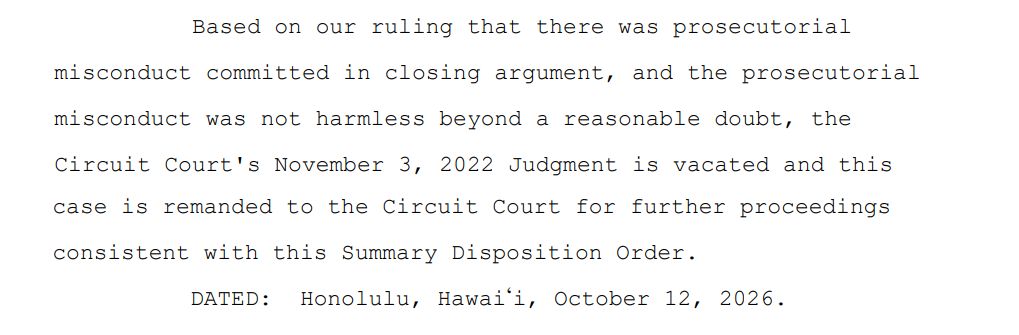
Appellate Verdict October 12, 2026 – Amen!
Luke 8:17 – “For nothing is secret, that shall not be made manifest; neither any thing hid, that shall not be known and come abroad.”
Listen: Unpacking the False Claims and Suspicious Death in Dr. Bekkum’s Case
In this audio overview, we explain critical aspects of Dr. Bekkum’s overturned case as it returns to Circuit Court.
This episode delves into: The “Hospice” Hoax: How an unlicensed individual falsely portrayed herself as a hospice caretaker to police, courts, and the public
This case has been a horrendous nightmare for a small community on Maui, Hawaii. Hana hasn’t had a permanent fulltime doctor for over 3 years. There is a lot of speculation about why Dr. Bekkum was targeted and whether it stems from the discovery and diagnosis of Rat Lungworm parasites brought onto the island and spread by his former employer, the reporting of an imposter portraying she was a “hospice” caretaker although she had no license or credentials, reporting the suspicious death to the police of the man the alleged hospice caretaker and her companion were “taking care of”, or the doctor’s clinic that was in competition with a questionable heath center operation – the facts will be made very clear in the remand back to Circuit Court.
The appellate decision addressed specific errors raised on appeal, but it did not resolve every factual dispute surrounding this case.
What about the evidence that was never fully investigated? The objections that were never made by the ineffective counsel? The damaging statements and strategic decisions that may have undermined the defense?
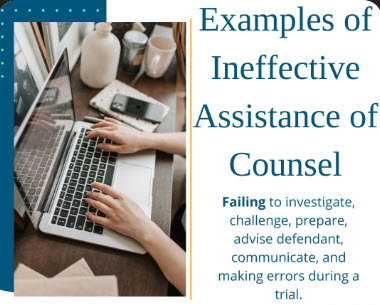
These are legitimate questions to examine against the trial transcripts, exhibits, investigative records, and defense counsel’s actual performance. If further proceedings take place, the scope of what may be raised will depend on the applicable procedural rules and the court’s rulings. The public should not confuse the rejection of particular appellate arguments with a finding that every aspect of the defense was beyond criticism.
There is also a broader history that deserves scrutiny. Dr. Bekkum’s involvement in the discovery of the rat lungworm matter and his former defense attorney’s role, as well as the concerns surrounding his attorney’s representation in this criminal case raise questions that should be addressed through documented facts. Some observers may see troubling connections; others may interpret the circumstances differently. Establishing whether those connections had any bearing on the criminal proceedings requires evidence, not assumptions about motive. The same standard must apply to everyone involved.
A community as small and closely connected as Hana deserves answers, not another round of unanswered questions. If the record reveals missed opportunities, inadequate investigation, or failures that compromised the defense, those matters deserve serious examination. And if there is evidence supporting concerns about conflicts of interest, chain of custody, or professional misconduct, it should be documented and brought before the appropriate authorities. The objective is not simply to assign blame. It is to establish what happened, what was overlooked, other motives, and whether Dr. Bekkum received the fair and effective representation to which every defendant is entitled.
The story behind this case reads like serious movie drama. A local resident loses his wife and is befriended by (a now disgraced) state senator. The senator promises to take care of “the man” for the rest of his life in exchange for the man’s waterfront property coincidentally in the same neighborhood as the properties Oprah acquired.
Oprah’s biggest real-estate investments in terms of acreage have been in Hawaii with it appears, per local sources, plans for development. She owns around 1,000 acres across two towns in Maui, Hāna and Kula, local news outlets KITV4 and Maui Now reported. It was reported in Celebrity Net Worth on June 21, 2022, that Oprah purchased the 3,600-acre property, known as Hana Ranch.

The man fell on his multi-million$ waterfront property around 2015 and after going to the hospital, the state senator arranged for him to recuperate in the Upcountry Maui Kula Hospital facility. Apparently, by 2016 the man wasn’t able to get himself out of the sanitarium, but through the help of friends and letters to the state the man was finally released and returned to his Hana home.
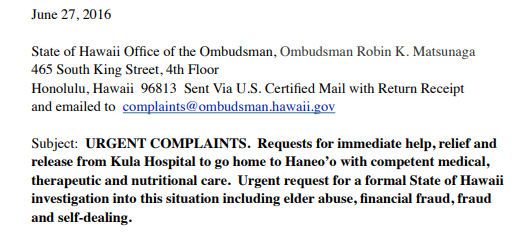
As the man was released from from Kula, a female alleging to be a “hospice caretaker” appeared and began telling anyone that would listen, including the police, the prosecutor, the court and the jury, that she was the “hospice” caretaker for the man brought to Hana by the state senator. She stated to police that the man, “wanted to be at home when he died,” and so the state senator “set it up is that he could be there, and I was his caretaker.”
However, she was not hospice licensed, nor even credentialed as a medical or healthcare assistant. She was merely the state senator’s aide.
The interesting point about making “hospice” claims is that it infers imminent death. Hospice is a type of medical care focused on providing comfort and support for individuals with terminal illnesses, prioritizing quality of life and symptom management rather than curative treatments. The woman essentially turned the man’s home into an unlicensed care home and when the man expired, she continued to operate under assumed hospice activity, even though she knew or should have known it was a false assumption.
The man was not a hospice patient or even in need of hospice. Dr. Bekkum made that perfectly clear.
In July 2016, a state adult abuse investigator showed up at the man’s residence and it is reported by witnesses that the woman caretaker went berserk and lunged at the investigator screaming “who called” the adult abuse division! Her companion had to drag her out of the house still screaming. She didn’t know at that moment the man had written a letter.

Local sources said the female caretaker (aka “the woman”) left the man’s residence after the state’s visit and didn’t return to his home until nearly mid August 2016. By September 4, 2016, after the woman had returned with her male companion, the man was pronounced dead at age 69. As a “hospice” patient, no autopsy was required. The man was quickly cremated (although he was Jewish making this an even more questionable act). Dr. Bekkum reported the suspicious death, as required to the police. Subsequently, the police officer investigating the case was also found dead.
After Dr. Bekkum reported the suspicious death to the Maui Police, a dubious complaint was filed by the alleged hospice caretaker against Dr. Bekkum, 8 months AFTER an alleged sexual assault, and nearly 2 years after the suspicious death of the man under the caretakers’ charge. When asked why the woman waited so long to file a complaint, her response was:
“I was afraid that if I did speak up, [the state senator] would take his side, and I could lose my job”
She was about to lose her job anyway because the state senator was under FBI investigation and eventually went to federal prison for 40 months in 2022. The investigation began when federal authorities uncovered “suspicious financial transactions linked to his office.”
It’s unknown if that was before, during or after the state senator placed his aide in Hana as a fake hospice caretaker.
The state senator ended up with the dead man’s $million+ waterfront property after the suspicious death and allowed the woman and her companion to continue to live on the property for over a year. Only after the woman lived rent free for an entire year on the estate, and then was asked to move out (after the doctor raised questions about the suspicious death to the state senator), did the woman decide to file a SA complaint well-after the alleged incident was said to have occurred.
The fake hospice caretaker’s complaint, statements, and accusations differed in almost every account, it all appears pretty much fictitious and reads like a fantasy novel. Her main theme was ‘he didn’t touch me, I just knew that he intended to’. She was decades older than the doctor, a married man with young children. The doctor was kind to everyone, but especially older folks. He took time and treated each one with his full attention. He took time to notice and study how you were feeling, your breathing, how you walked or stood up, and always had a nice compliment or two to make you feel special.
Dr. Bekkum had helped the woman with a back problem and gave her Ketorolac (an ibuprofen), to which she incorrectly claimed over and over at nauseum it was cortisone, a steroid. The state had pictures of the Ketorolac provided by Dr. Bekkum, that it appears she supplied or the police took photos of, so the state knew or should have known that the doctor did not give her cortisone.
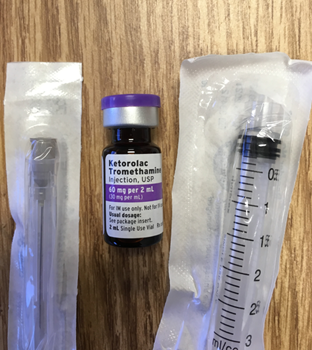
Since the facts were inaccurately presented at trial in the preceding case – here is an outline so the prosecutor won’t get confused. Reading the transcripts and reviewing the exhibits, its obvious he was misinformed. The prosecutor’s statements mimicked the woman’s testimony – and her testimony appears to have been intentionally erroneous and misleading.
- The “hospice” caretaker aka “the woman” was NOT a licensed or certified hospice caretaker or healthcare worker. Unlicensed hospice caretaker claim is a crime. Her statements as a hospice caretaker in court and to the police are fabricated.
- “The man” that the woman was caretaking for was not a hospice patient, nor did he have a hospice doctor and was not facing imminent medical death.
- The man died on September 4, 2016, not 2017 as the prosecutor and the caretaker stated to the police, court and the jury.
- The woman made several statements that the man’s death was in 2017, a rather significant mistake, as if she wanted to distance herself from his death. Apparently, a year sounds better than “3 months later, he died”.
- Other issues that will be key are, where did the state’s trial exhibits come from and what was the chain of custody? The exhibits have now been professionally forensically examined and were found not to be the iPhone “screenshots” the woman claimed to have taken with her iPhone. They had been manipulated, altered, and/or altogether fabricated, and the overall opinion was that they were unverifiable, and certainly not credible.
- The police video of the hospice caretaker’s sexual assault allegation on May 11, 2018 against Dr. Bekkum should be front and center before the court this time. The video tape of the police complaint has since been examined by body language experts and found to have numerous universal “tells” of someone making false statements. Once you see it, you can’t unsee these obvious “tells” that give way to falsifications.
- When thoroughly compared and examined, the woman’s stories are not credible, just like her hospice caretaker claims. There are numerous differing accounts of allegedly what happened that are found in the various statements the woman made in court, to police officers, in her alleged texts, and to other professionals.
- The woman said she thought she was alone with the doctor. She didn’t know that his daughter was right outside her door both days, in the car waiting for her father. His daughter could see and hear everything because the windows and screen on the doors were open. (State’s 2022 Trial Exhibits 1-8 House pictures). The doctor’s daughter’s account is incredibly different from the woman’s complaint and wasn’t known until after the trial, because no one, not even the defense attorney thought to ask about other possible witnesses.
- As part of the exhibits provided by the state included several pages of Facebook text messaging that the forensic professionals said were not worth dissecting because they were obviously manipulated, out of sequence, and unverifiable. The messaging appears fabricated, is missing context and detail as if it were cut and pasted.
- One specific FB message was put to the “truthful” test and could not pass. On Sept. 9, 2017, the woman wrote:

In order to bring ashes legitimately into Hawaii there are legal hoops one has to go through with the airlines, the state notifications, as well as precisely where they were scattered can raise questions. But it was the statement, “Both my parents died while I was living in Hana” that raised the first red flag. The woman’s father died in July 2015 and his wife is still alive when the text was written. The woman’s biological mother died in AZ in 2013 and was long-time divorced from her father. Moreover, if the woman lived in Hana before June 2016, how was she working for the state senator in Honolulu? She lived on the dead man’s estate after his suspicious death. Are there any credible text messages about going back to Missouri to collect her family ashes? Even her mainland family didn’t have any information or confirmation to that fact. Was she living in the dead man’s home while he was detained against his will in the Kula facility? Was she also part of that fiasco too?
When the woman’s not truthful about one issue it could be overlooked or maybe even justified, but in this case the numerous misrepresentations, false statements, and questionable activities are mounting – too much to ignore, how can she be believed about anything she has stated?
As if this lying atrocity wasn’t enough, a community source points to a conspiracy, a ring of FaceBookers conspiring to discredit the doctor as early as November 2017, and switch the narrative away from the dead man facts that the doctor could provide. The woman had contacted several attorneys and the doctor’s insurance company well before she ever went to the police – 8 months later in 2018. Why wait so long? Maybe to concoct a story? Maybe more time was needed so her hospice caretaker scheme would seem to have more distance from her, like her false claims that “he died in 2017” – rather than the reality of September 4, 2016? Maybe time was needed to see how lucrative the allegations would be? Sources say there were reputable attorneys that turned her away.
It became obvious after the facts were put in chronological order, that the woman and her friends were targeting the doctor. Apparently, they were not very smart, and it appears the leader of the group didn’t do much criminal investigation or history on the players or didn’t care. A local source said that one of the players was stupid enough to send threatening texts messages to the doctor and demand money and/or prescription drugs.
Another source reported that the same player had been in the doctors’ office with the doors open and ran by them stuffing Kleenexes in her pockets. It was odd, and a few minutes later the doctor and his wife came out and said that his snotty Kleenexes that were on his desk from his runny sinus’ – were missing.
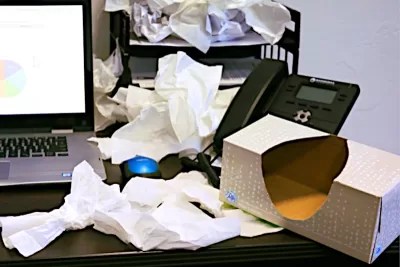
It appears the player didn’t know that snot and semen would test differently, nor was she smart enough to think about someone in the waiting room seeing her.
The lack of truthfulness throughout this entire ordeal, including the hospice caretaker hoax, makes any statement this woman would again utter indeed questionable and skeptical to a point where any honest person would have trouble believing her beyond a reasonable doubt.
Las Vegas would probably book the woman at 50-1 odds to even show up again. 50-1 odds, for example, it means that there is a 2% chance of her showing up. So much more is known now, that certain questions cannot be avoided and must be answered. i.e. Specifically what happened to the man – your “hospice” patient?

For a small, isolated community like Hana, the consequences of this case extend far beyond a courtroom. When a community has been subjected to years without a permanent, full-time doctor, the loss of a physician and the uncertainty surrounding the circumstances can have lasting repercussions. People died. The questions raised throughout this case deserve careful examination, including the discrepancies in the testimony, the origins and authenticity of the exhibits, and the events that preceded the allegations. The appellate court has now vacated the judgment after finding that prosecutorial misconduct during closing argument was not harmless beyond a reasonable doubt. That is a significant development, but there is still more to understand. Who really was this woman and why did she run away to another state?
Certainly, the suspicious death, the alleged hospice issue, the manipulated, manufactured, and altered alleged iPhone screen shot(s) evidence and details will be called into question this time. And before another state appeal tactic buying more time or delaying the truth, the state should guarantee the complaining woman will ultimately return for a new trial, and be held accountable for the various facts, misrepresentations, and issues herein.
As the case returns to the Circuit Court, the public should resist speculation and insist instead on answers grounded in verifiable evidence. Were the inconsistencies adequately investigated? Can the origins and integrity of the exhibits be established? Have all relevant facts been considered? And will the remaining proceedings bring greater clarity to the questions that have weighed on this community? These are not questions that should be answered by rumor, emotion, or assumption. They should be answered by the evidence and the record. For Dr. Bekkum, for the people of Hana, and for public confidence in the justice system, the hope is that the next chapter will bring the transparency, fairness, and accountability this case demands.
See “She Was Done With Maui” January 23, 2025
Please DONATE and keep sharing Dr. Bekkum’s VENMO account, another court process is going to be expensive. Please know that all future donations will be put into our separate saving account and used to help us cover future retainers and legal fees, witnesses costs and expenses. Thank you so much for your Donations.

Venmo is a faster, safer, more secure process to DONATE – and doesn’t ask you for a tip.
See also: How to Prove Innocence When Falsely Accused of Sexual Assault – Part 1
***All details and facts within are accurate to the best of our knowledge. We do not intend to be inflammatory to any party involved. As this is an ongoing legal matter, We will not provide the names or other personal details of those involved unless it is part of the court or public record.***
We are litigation paralegals. We are not attorneys. Nothing in this post should be construed as legal advice. If you are need legal advice, please contact an attorney.
Disclaimer: This Gemini Notebook-generated audio overview and accompanying commentary are provided strictly for educational, informational, and news commentary purposes regarding ongoing legal matters and public records. Nothing in this audio recording or post constitutes formal legal advice. All statements are based on trial records, appellate rulings, forensic findings, and publicly available reports. As this matter remains active in the courts, listeners are encouraged to review official court records and filings directly.

