October 14, 2018
TODAY’S SHOW HAD TO BE CANCELLED DUE TO AN EQUIPMENT MALFUNCTION AT THE AM RADIO STATION THAT SENDS OUT OUR SIGNAL TO THE WORLD. ALL OF OUR SHOWS ARE BROADCAST LIVE FROM OUR LAW OFFICE TO THE RADIO STATION WHICH TRANSMITS OUR SIGNAL.
AS A RESULT, THIS SUNDAY’S SHOW WILL BE BROADCAST NEXT SUNDAY, OCTOBER 21, 2018.
WELCOME TO THE FORECLOSURE HOUR
Your weekly national foreclosure talk show.
Listen in. Call in. Make your voice heard.
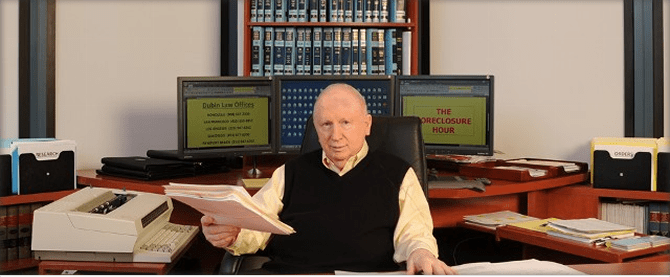
Your Host: Attorney Gary Victor Dubin
with
Co-Host: Former Hawaii Governor John D. Waihee 
Foreclosure Workshop #70: Bank of America v. Reyes-Toledo (October 9, 2018) (Reyes-Toledo 2) — Hawaii Supreme Court Frees Hawaii Homeowners from Decades of Wrongful Federal Judicial Interference with Their State Court Foreclosure Defense Rights, Which New Published Opinion Should Become a Model for Every State Judiciary
I have mentioned on numerous shows that the federal courts are generally a virtual graveyard for homeowners being foreclosed on, and I meant that as no exaggeration.
For I have been an eye-witness advocate to decades of the mindless arrogant slaughter of homeowners’ rights in federal courts, generally ignoring Truth-in-Lending rescissions, ignoring loan modification abuses, ignoring the lack of good faith and fair dealing in nonjudicial auctions, ignoring the adequacy of notice pleading, and ignoring the many fraudulent and undisclosed low visibility practices within MERS and REMIC securitized trust paper hocus pocus mumbo jumbo.
And those errant federal decisions moreover have corrupted the foreclosure defense jurisprudence of most state court foreclosure defense adjudications as well, including in Hawaii Courts, kowtowing and genuflecting to federal court decisions in the foreclosure field — until now.
 The Hawaii Supreme Court in its first, 2017 Reyes-Toledo decision, after earlier handing down numerous welcome published opinions clobbering nonjudicial foreclosure abuses, began an effort to control abuses in an otherwise hidden and unregulated securitized banking system by requiring judicially foreclosing plaintiffs to prove ownership and possession of the promissory note and right to foreclosure at the exact time it filed its foreclosure complaint, which created the equivalent of a “10” on the Richter Scale, sending foreclosure attorneys in Hawaii scampering for proof of note ownership while frequently merely filing to dismiss existing deficient foreclosure complaints.
And now, in its most recent, 2018 Reyes-Toledo decision, it calls Reyes-Toledo 2, the case returning to it on certiorari following its earlier remand to the Hawaii Intermediate Court of Appeals, the Hawaii Supreme Court has now taken the gloves off, as it were, squarely rejecting the federal court “plausibility” dismissal standard as well as allowing wrongful foreclosure counterclaims to be filed in every foreclosure case without a homeowner having to wait until being foreclosed on before suing for wrongful foreclosure.
 This 2018 common sense approach, preventing contrary federal court pleading standards in foreclosure cases in Hawaii State Courts from similarly shutting courthouse doors to homeowners in foreclosure in State Court is another example of combatting what our listeners know as The Rule Ritual.
Even more importantly, Reyes-Toledo 2 now creates, at least in Hawaii, a split in case outcome, applying different dismissal standards in the Federal District Court and the State Courts in Hawaii, in Honolulu ironically located across the street from one another.
On today’s show we will highlight the absolutely unfair, discriminatory, and lacking in due process differing result triggered not on the merits but based on which pleading standard of review is used, by exploring a recent Federal District Court dismissal in the Dairy Road Partners case now on appeal to the Ninth Circuit Court of Appeals, our challenging the “plausibility” dismissal standard there, anticipating our asking the United States Supreme Court to accept certiorari and to reconsider that standard of review.
 For, if a pleading standard is dispositive of a case, why should not the state dismissal standard be required instead, at least where a state claim based on diversity of citizenship is pled?
Listen this Sunday while John Waihee and I discuss today’s landmark Hawaii Supreme Court Case, Reyes-Toledo 2, a copy of which will be posted on our website, http://www.foreclosurehour.com, in our “past broadcast” section shortly after the show.
No homeowner or foreclosure defense counsel can afford to miss today’s broadcast introducing the remarkable Reyes-Toledo 2 which has clearly placed Hawaii Courts at the forefront of foreclosure reform.

Gary Victor Dubin
Dubin Law Offices
Suite 3100, Harbor Court
55 Merchant Street
Honolulu, Hawaii 96813
Office: (808) 537-2300
Cellular: (808) 392-9191
Facsimile: (808) 523-7733
Email: gdubin@dubinlaw.net
Licensed in California and Hawaii
You are getting a 2nd chance – don’t miss it! But if you do you can find the archived broadcast right – HERE.
 Deadly Clear
How does a Foreclosure case get to a Federal Court? The diversity statute. would seem to prevent it from removal
Reblogged this on Deadly Clear and commented:
Coming on tomorrow at 3:00 pm HST.