
Renewing the Statute of Limitations Accidentally: Modifications and Payments

Unknown's avatarLivinglies's Weblog

It seems apparent to me that the banks are sidestepping the statute of limitations issue by getting homeowners to renew payments after the statute has run. Given the confusion in Florida courts it is difficult to determine with certainty how the statute will be applied. But the execution of a modification agreement would, in my opinion, almost certainly waive the statute of limitations, particularly since it refers to the part of the alleged debt that was previously barred by the statute. It would also, in my opinion, reaffirm a discharged debt in bankruptcy.

THE FOLLOWING ARTICLE IS NOT A LEGAL OPINION UPON WHICH YOU CAN RELY IN ANY INDIVIDUAL CASE. HIRE A LAWYER.

—————-

There are several reasons why servicers are offering modifications and several other reasons why they don’t.

My perception is that the main reason for offering the modification is that the servicer is converting the ownership of…

View original post 383 more words
Who Can Go After Banks for the Foreclosure Crisis?

Unknown's avatarLivinglies's Weblog

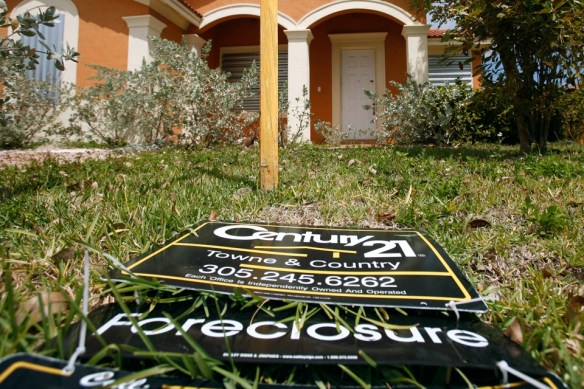
Foreclosures States FILE – In this March 24, 2009 file photo, a sign lies on the ground in front of a foreclosed home in Homestead, Fla. Officials in 49 states have launched a joint investigation into allegations that mortgage companies mishandled documents and broke laws in foreclosing on hundreds of thousands of homeowners. (AP Photo/J Pat Carter, File)

Editors Note: When Banks defraud American cities out of county recording fees and saddle them with the maintenance of foreclosed real estate that the banks have abandoned or neglected- cities lose revenue.  The cities are then unable to care for the homeless families that were displaced by the banks and may neglect to provide basic municipal services like public water, sanitation or maintain the infrastructure.

The city of Detroit is a perfect example of how a bankrupt city was unable to properly carry out its assigned responsibilities to its citizens due to financial deficiencies…

View original post 380 more words

4th DCA Florida: Exploding the Merger Myth

Unknown's avatarLivinglies's Weblog

Achieving standing via merger also requires that the surviving entity prove that it “acquired all of [the absorbed entity’s] assets, including [the] note and mortgage, by virtue of the merger.”Fiorito v. JP Morgan Chase Bank, Nat’l Ass’n, 174 So. 3d 519, 521 (Fla. 4th DCA 2015).

see http://4closurefraud.org/2016/06/07/fl-4th-dca-segall-v-wachovia-bank-na-reversed-wachovia-failed-to-prove-standing-to-foreclose/

Finally the courts are turning back to the simple rules of law that always applied until the era of false claims of securitization. Hopefully this decision will be persuasive authority in all jurisdictions. As stated in other cases, the banks can’t continue to operate using multiple choice assertions. Either their entity is real or it isn’t. Either they acquired the loan or they didn’t — and the fact that there was a merger does NOTHING for them in asserting transfer of the loan. They must show that the subject loan was in fact acquired by the surviving entity in the merger…

View original post 15 more words

UNSEALED: DOJ Confirms Holders of Securitized Loans Cannot Be Traced

Exactly what was just discussed. It’s time to put the judges on the hotspot – “please define the terminology your honor” – what do the words “transfer” and “sold” mean to you? Do the four corners of these notes and mortgages contracts allow for the distorting of legal principals without disclosure?

justiceleague00's avatarJustice League

Great job by 4closurefraud website!

Originally posted at http://mortgageflimflam.com
With additional edits by http://4closurefraud.org

In a filing unsealed on June 3, 2016, the Department of Justice (DOJ) confirms what many of us have known for years. Nobody, not even the U.S. Government, with massive resources, can determine who owns your loan and has the right to collect on your mortgage.

The information comes from case files unsealed on June 3, 2016 by federal Judge Yvonne Gonzalez Rogers of the Northern District of California in the case of the United States v. Discovery Sales, Inc. The case involves some 325 fraudulent loans originated by Discovery Sales, Inc. (DSI) between 2006 and 2008, many of which were then sold to Wells Fargo Bank and JP Morgan Chase to securitize.

The Discovery Sentencing document on page 9 states:

The originating lenders who made loans to purchase DSI properties, including Wells Fargo…

View original post 325 more words

One Step Closer: It’s Impossible to Tie Any Investors to Any Loan

THIS POST HAS BEEN MOVED TO GARFIELD’S BLOG:

Interesting thought here as I read Chain of Title which makes a point to say the investors don’t own the actual loan. We now have documents that identify the mortgagors as a third-party to the process between the banks (and of course they would have to be since they unwittingly, with no disclosure, pledged their collateral); and, agreements defining the unlimited use of the collateral assets to pledge, repledge, reuse, rehypothecate, hypothecate – all of which the homeowners did not agree or allow by contract. It is time to make judges define their understanding of the word “transfer” in the note and “sold” in the mortgage.

These are not traditional mortgages. The securitization and “procurement of collateral” agreements were pre-existing to the faux mortgage and note documents and the homeowner’s signature. However, there was no disclosure to the homeowner. These were internally contracted securities transactions.

BASIC INC. v. LEVINSON, 485 U.S. 224 (1988) identifies fraud on the market. Omission is just as serious as misrepresentation.

Unknown's avatarLivinglies's Weblog

The current talking points used by the Banks is that somehow the Trust can enforce the alleged loan even though it is the “investors” who own the loan. But that can only be true if the Trust owns the loan which it doesn’t. And naming the “investors” as the creditor does nothing to clarify the situation — especially when the “investors” cannot be identified.

THE FOLLOWING ARTICLE IS NOT A LEGAL OPINION UPON WHICH YOU CAN RELY IN ANY INDIVIDUAL CASE. HIRE A LAWYER.

—————-

see http://4closurefraud.org/2016/06/07/unsealed-doj-confirms-holders-of-securitized-loans-cannot-be-traced/

I know of a case pending now where US Bank allegedly sued as Trustee of what appears to be named Trust. In Court the corporate representative of the servicer admitted that the creditor was a group of investors that he declined to name. I knew that meant two things: (1) neither he nor anyone else knew which investor was tied to the subject…

View original post 975 more words

The Onset of Depression During the Great Recession: Foreclosure and Older Adult Mental Health

Unknown's avatarLivinglies's Weblog

ForeclosureChildrenDorothea-Lange-y

87 Years Later & What has Changed in America?

If you have comments about this study please post in comments or email us your story at: info@lendinglies.com.  We will be compiling your comments and emails from this post and sending them to various agencies so they can understand the devastating psychological impact of Foreclosure on the American homeowner.  Please indicate your loan servicer(s) and current status.  All names and identifying information will be removed from comments and emails.  Thank you.

Tip to 4closurefraud.org for finding this tragic and relevant article.

The Onset of Depression During the Great Recession: Foreclosure and Older Adult Mental Health

Study here:Foreclosure and Depression

The Onset of Depression During the Great Recession: Foreclosure and Older Adult Mental Health

Objectives. We examined neighborhood-level foreclosure rates and their association with onset of depressive symptoms in older adults.

Methods.We linked data from the National Social Life, Health

View original post 788 more words

Elizabeth Warren Slams Donald Trump’s “Huge Conflicts of Interest”loans from Deutsche Bank

justiceleague00's avatarJustice League

Earlier this week, Mother Jones reported that Donald Trump’s loans from the German-based Deutsche Bank—totaling at least $100 million and possibly much more—would pose a significant conflict of interest, should Trump, the GOP’s presumptive nominee, become president. After all, the bank was recently caught manipulating markets around the world (and had to pay $2.5 billion in fines), and it has tried to evade US laws aimed at curtailing risky financial shenanigans and has attempted to influence the US government via lobbying.

Richard Painter, an attorney who teaches at the University of Minnesota and who was the chief ethics lawyer for President George W. Bush from 2005 to 2007, noted that Trump’s relationship with the overseas financial giant was disturbing: “Having a president who owes a lot of money to banks, particularly when it’s on negotiable terms—it puts them at the mercy of the banks and the banks are at the…

View original post 136 more words

Tonight on the Neil Garfield Show: Unconscionable in Adhesion Contracts with South Florida Attorney James “Randy” Ackley

Unknown's avatarLivinglies's Weblog

radio The Neil Garfield Show Tonight! 6 pm EST

——–THE FOLLOWING ARTICLE IS NOT A LEGAL OPINION UPON WHICH YOU CAN RELY IN ANY INDIVIDUAL CASE. HIRE A LAWYER——–

Click in to tune in The Neil Garfield Show

Or call in at (347) 850-1260, 6pm Eastern Thursdays

By William Hudson

Tonight Attorney James Randy Ackley returns to the Neil Garfield Show and will continue the conversation about adhesion contracts he touched on during the  April 29, 2016. broadcast.  During the show, Ackley discussed raising issues of unconscionability in regards to defending against foreclosure.

Unconscionable or oppressive loans are all too common. Take for example, a borrower with limited income who refinances his $1.5 million dollar loan, only to default after five monthly payments. A Notice of Default is subsequently recorded, followed by a Notice of Trustee’s Sale and finally a Trustee’s Deed Upon Sale is recorded just shy of one…

View original post 980 more words

AM! JURY AWARDS MAN $2.5M IN PUNITIVE DAMAGES AGAINST OCWEN FOR WILLFULLY VIOLATING THE FCRA

justiceleague00's avatarJustice League

DAUGHERTY v. OCWEN LOAN SERVICING, LLC

U.S. District Courtcase number 5:14-cv-24506

BECKLEY – A Wood County man will receive more than $2.5 million after a federal jury said a mortgage service company didn’t investigate his repeated disputes of his credit report.

A federal jury on May 23 awarded $6,128.39 in compensatory damages and $2.5 million in punitive damages to David M. Daugherty of Vienna. He had sued Ocwen Loan Servicing LLC and EquifaxInformation Services LLC in Raleigh County in 2014. The defendants had the case removed to federal court.

After a six-day trial before Judge Irene Berger, the jury ruled in favor of Daugherty, saying Ocwen willfully violated the Fair Credit and Reporting Act. One component of that act requires that a company investigate all disputes. Daugherty had filed several disputes with Ocwen after receiving Equifax credit reports showing him behind on his mortgage payment.

More here…

View original post

Red Oak Merger Corp. a/k/a Countrywide, a/k/a BAC a/k/a Bank of America

Unknown's avatarLivinglies's Weblog

When BOA says it is a “Successor by merger” to Countrywide, it is no more true than Chase’s claims that it is the successor by merger to WAMU and no different than the false claims of OneWest as to IndyMac. In each instance there was a merger but in none of them were loans acquired because they had already been sold.
If you look at the actual merger disclosures, it is highly doubtful and even inconsistent with other disclosures that Bank of America Corp or Bank of America N.A. actually owns any loans originated by Countrywide. In fact, as you drill deeper you will be drawn to my conclusion —— that Countrywide was a conduit and not a lender, who operated through other thinly capitalized “originators” none of whom were actually making loans.
None of them were lenders. None were creditors. The money for the alleged loans…

View original post 582 more words